10 Ways to Reduce Mental Load as a Parent
Feeling like you're carrying the weight of your family's schedule in your brain? You're not alone. Here's how to lighten the load.
You remember the dentist appointment, the school bake sale, the permission slip, the football cleats that need replacing, and the fact that it's your turn to bring snacks on Friday. Your partner remembers... none of it.
This invisible burden is called mental load — and if you're reading this, you're probably carrying most of it right now.
TL;DR: Mental load is the cognitive work of managing a family that mostly falls on one person. This article shares 10 practical strategies to reduce mental load as a parent — from shared calendars to AI task extraction — so you can stop being the sole keeper of your family's entire existence.
What Is Mental Load (And Why Does It Never Switch Off)?
Mental load is the cognitive work of managing a household: the constant planning, anticipating, delegating, and tracking that keeps family life running. Unlike physical chores, it's invisible — and it's almost never shared equally.
For most families, one person holds the mental map of the entire household in their head at all times. You're tracking what's in the fridge, who has football practice, when the MOT is due, and whether anyone replied to the school trip email — all simultaneously, all the time.
Research by Bright Horizons found that working mothers spend over two hours per day on household mental management — even on days they're also at work. It means you're never truly "off duty," even when you're supposed to be resting.
Why the Mental Load Matters More Than You Think
Carrying an unequal mental load leads to burnout, resentment, and a constant undercurrent of overwhelm — even on weekends. It chips away at your enjoyment of family life.
When you're mentally cataloguing next week's school lunches during a family film night, you're not really present. And that disconnect accumulates. The good news? The mental load can be reduced — not by doing less, but by sharing the cognitive work more fairly and building systems that remember things so you don't have to.
How to Reduce Mental Load as a Parent: 10 Strategies
1. Make the Invisible Visible
Before you can share the mental load, you have to surface it. Write down every single recurring task and responsibility you manage in a typical week — the school newsletter check, the uniform day reminders, the medication tracking, the party invitation replies.
Seeing it all on paper (often a full page or two) is frequently the first shock. It's also the first step. When your partner can see what you're carrying, the conversation about sharing it becomes much more concrete.
2. Build a Shared Family Calendar
If each family member has their own calendar app and their own mental model of the week, nobody sees the full picture. Move to a shared family calendar where both parents — and eventually older children — can see upcoming events, appointments, and commitments in one place.
The calendar itself isn't magic. The agreement that both partners are responsible for checking it and adding to it is what makes it work.
3. Let AI Do the Tracking
Most mental load starts in your inbox. School trip confirmations, dental appointment reminders, club deadlines, sports fixtures — they all arrive as emails you have to read, mentally note, and somehow track.
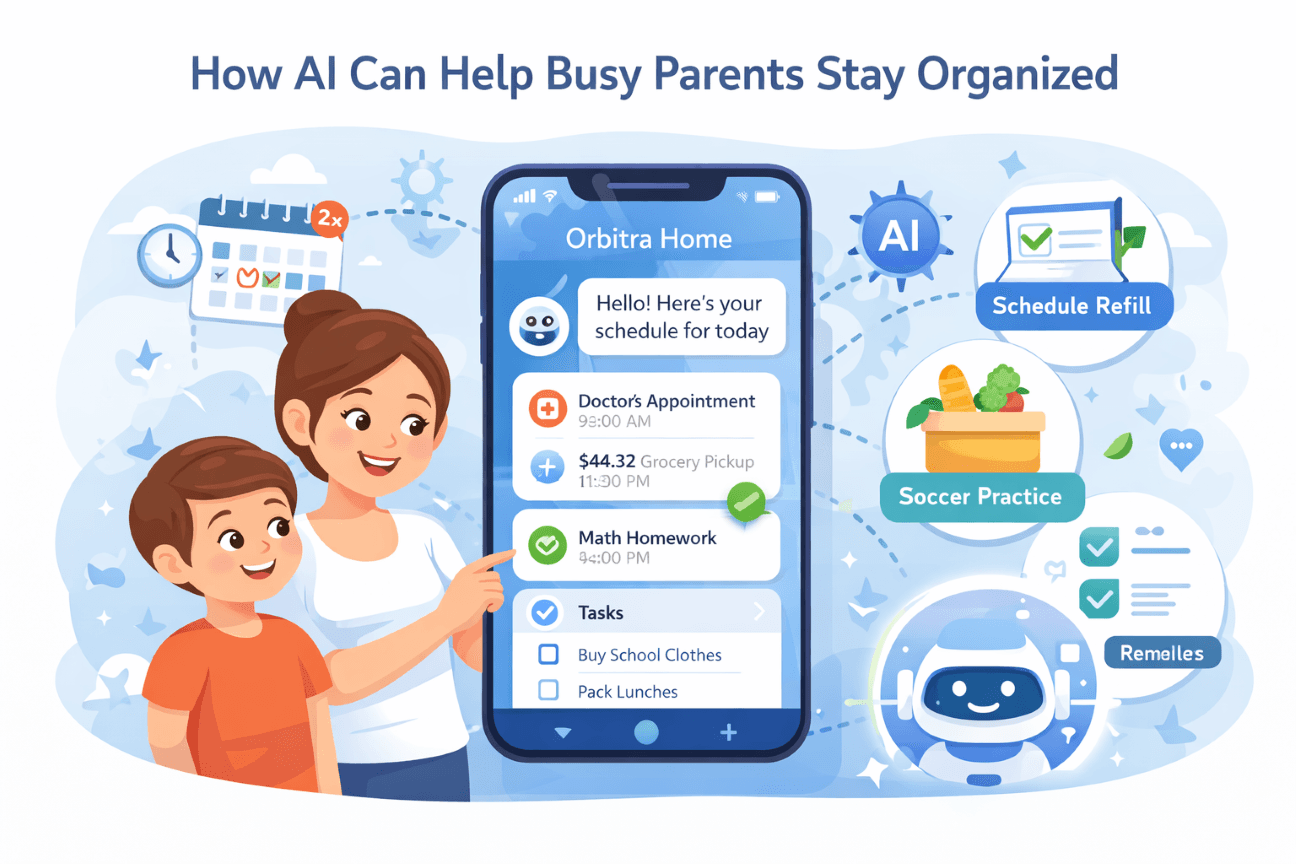
Tools like Orbitra Home can automatically extract tasks from your emails, so you're not the human middleware between your inbox and your to-do list. The dentist reminder becomes a task. The school trip deadline becomes a calendar event. Your brain gets a rest.
💡 Quick Tip: Orbitra's AI assistant reads your Gmail and turns important emails into tasks and calendar entries automatically. No more "I meant to deal with that" moments. Try it free →
4. Hold a Weekly 10-Minute Family Review
A short Sunday evening check-in — just 10 minutes — can prevent hours of mid-week chaos. Run through the week ahead together: who has what, who needs to be where, what actions are outstanding.
No more "I didn't know about that!" surprises on Tuesday morning. No more "I thought you were handling it." Everyone enters the week informed.
5. Assign Ownership, Not Just Tasks
There's a big difference between "can you take care of this?" and "you own this area." When you ask for one-off help, you're still holding the mental load — you're delegating the doing, not the remembering.
Instead, assign ownership of entire domains:
- One parent owns all school communications
- The other owns all medical appointments
- One handles the weekly shop; the other handles birthday logistics
When ownership is clear, you stop needing to ask, remind, or chase.
6. Create Templates for Recurring Situations
School holidays, birthday party planning, packing for trips, Christmas prep — these happen every year. If you're figuring them out from scratch each time, you're wasting mental energy unnecessarily.
Create simple checklists and store them somewhere both parents can find. A "what to pack for a weekend away" note saves 20 minutes of mental reconstruction every single time you travel.
7. Involve Your Kids in Running the Household
Even young children can take ownership of age-appropriate tasks: packing their own snack, laying out their school uniform the night before, tracking their own club schedule. It builds their independence — and genuinely reduces your load.
Start small. A 5-year-old can put their shoes by the door. A 9-year-old can pack their own lunchbox. Every task they own is one less for you to carry.
8. Batch Your Family Admin
Instead of responding to every school email as it arrives, set aside 15 minutes twice a week for all family admin. Open everything at once, action or archive, and move on.
Batching reduces the cognitive cost of constantly context-switching — re-engaging with a new task every time an email lands. It also means you're not mentally half-managing email threads throughout the entire day.
9. Say No More Strategically
Every commitment you make for your family adds to the mental load. Every after-school activity has logistics. Every playdate has a pickup time. Every birthday party has an RSVP deadline.
Be deliberate about what you take on. You're not being antisocial — you're recognising that you're the one who'll manage the logistics, and your bandwidth has real limits.
10. Let Go of Perfection (Seriously)
Perfectionism is one of the biggest drivers of mental load. The birthday cake doesn't need to be homemade. The permission slip just needs to be signed. The school uniform doesn't have to be ironed.
"Good enough" isn't failure. It's a sustainable way to manage a full life. Every time you resist the urge to redo something your partner did "wrong," you're actively reducing your own mental load — and giving them room to actually help.
The Real Goal: Systems That Remember So You Don't Have To
Reducing mental load as a parent isn't about doing less — it's about sharing the cognitive work more equally and building systems that handle the tracking automatically.
Start with just one or two strategies. Maybe it's the shared calendar. Maybe it's the weekly review. Small shifts compound into real relief over time. And you deserve to feel present in your own family life — not just the project manager of it.
Ready to Lighten the Mental Load?
Stop carrying your family's entire schedule in your head. Orbitra's AI assistant automatically extracts tasks from your emails, syncs everything to a shared family calendar, and gives you a clear daily digest — so you can focus on your family, not the logistics.
✨ What you get:
- AI task extraction from Gmail
- Unified family calendar
- Personalised daily digest
- Family chat assistant
- 7-day free trial, no credit card required
Get Orbitra Free | Learn More →
You Might Also Like
- Work-Life Balance for Dual-Income Families: 7 Strategies - How the families who crack it think differently about coordination
- How to Never Miss an Important Email Again - A simple system for managing school and family emails without the stress
- How AI Can Help Busy Parents Stay Organised - What AI can genuinely do for your family — and what it can't
Found this helpful? Share it:
Don't miss our next post
Get family productivity tips delivered weekly
We respect your privacy. Unsubscribe anytime.